Slate roof repair costs in Sydney: warning signs, 2026 prices and how long you can wait
Written by Scott Barton, owner of First Class Slate, who has repaired and re-slated Sydney slate roofs for 20 years and is on site for every job.
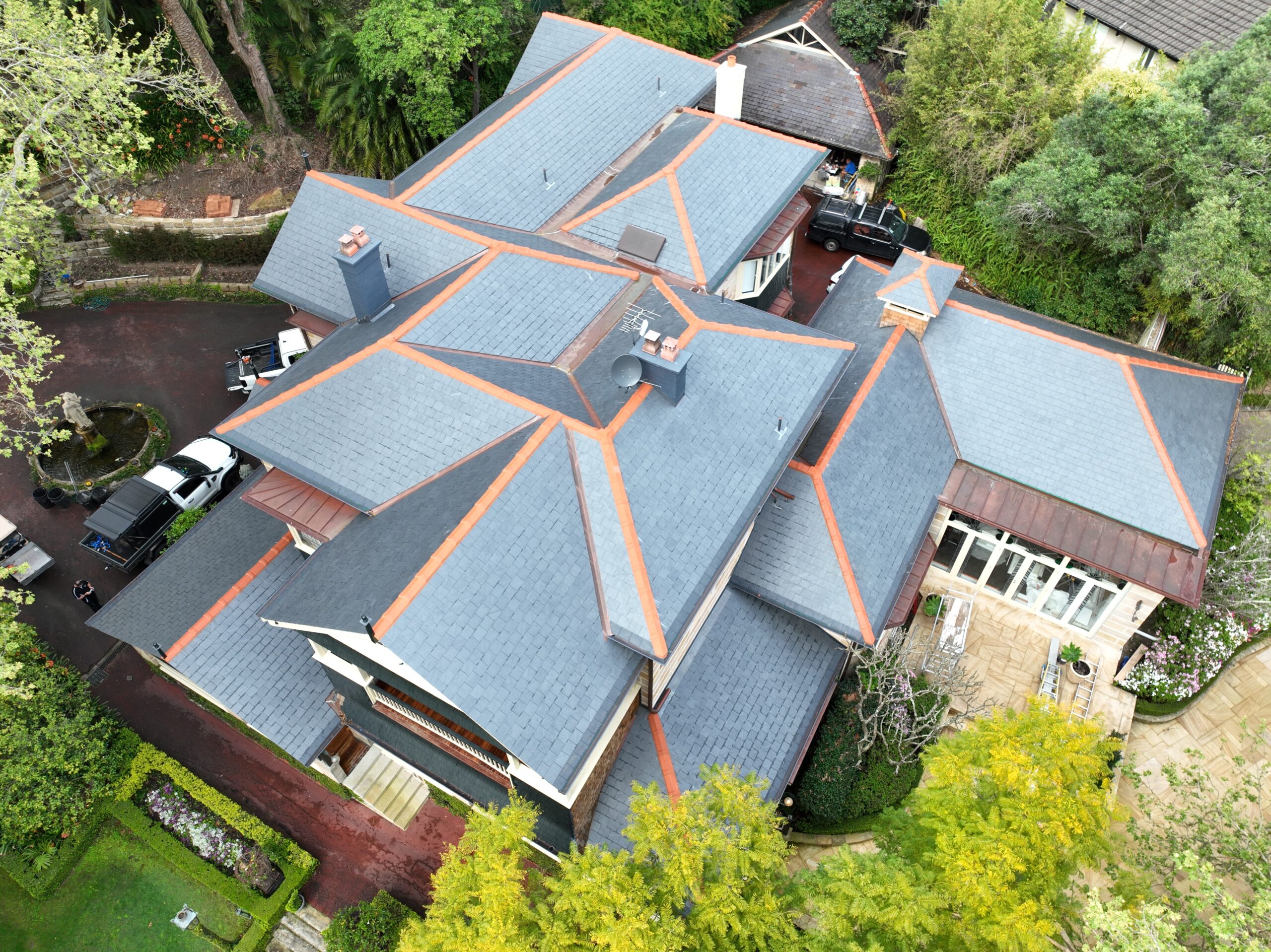
In Sydney in 2026, most slate roof repair jobs cost between $1,200 and $8,000. Individual slates run $20 to $45 each, lead flashing $120 to $220 per linear metre, and scaffolding adds $1,400 to $3,000 on a two-storey home. If fewer than about 20% of the slates have failed and the nails are sound, repair the roof. If more than 20% have failed or nail sickness is confirmed, a full re-slate is usually the better spend.
A single slipped slate on a Federation terrace in Paddington can send five litres of water through a lath-and-plaster ceiling before the next storm clears. Most slate leaks start that quietly, and most owners find out about them the morning after the first serious rain of autumn, when a plaster blister appears above the stairs.
This is for anyone in Sydney who has noticed something off about their slate roof and is trying to decide whether to leave it, patch it or budget for a full re-slate. It covers what to look for from the ground, what competent slate roof repairs in Sydney actually cost in 2026, and the test a 20-year slate roofer uses to decide whether a roof is still a repair job or has crossed over into replacement.
Seven signs your slate roof needs attention
- A slate on the lawn. Even one slate on the ground is the roof telling you a fixing has let go. Slates do not blow off a sound roof in a normal Sydney storm. They fall because the galvanised nail holding them has rusted through, and one slate usually means more are loose up there.
- Hairline cracks across a slate. Walk around the house on an overcast morning and look up. Hairline cracks show as thin dark lines across the face of a slate. A cracked slate still sheds most water, but the ones you can see are rarely the only ones. Cracks come from footfall, falling branches, or a tradie standing on the wrong slate years ago.
- Moss or lichen sitting proud. A thin film of lichen is cosmetic. Moss cushions you can see from the street are not. They hold water against the slate for days, soften the mortar beneath them, and send roots into the bedding. Southern faces in Mosman and Hunters Hill carry this worst.
- Lead flashings looking tired. Lead at the chimney, dormer and ridge should sit flush and look dull grey. If it is bulging, split along the top edge, or weeping chalky white, the lead has fatigued. On most Sydney roofs the lead goes long before the slate does.
- A ridge that sags, dips or sprouts weeds. A sound ridge sits straight as a ruler. A dip means the mortar bed has let go and the ridge tiles are only being held by friction. Weeds growing out of the mortar line is the same story, told slower.
- Water staining or a wet-leaf smell inside. A ring on the plaster, a damp spot on the top-floor cornice, a mildewy smell in the hallway after rain. By the time water reaches the plaster it has usually been in the roof cavity for weeks and is sitting in the sarking or the ceiling batts.
- Valley irons that look rough or holed. The galvanised or lead valleys down the inside creases of a roof take more water than any other part of it. When they split or corrode through, water runs straight into the eaves. On any slate roof over about 60 years old these are the first thing to inspect.
Slate roof repair costs in Sydney: 2026 price guide
Prices below are what the work typically runs in Sydney in 2026, supplied and installed, exclusive of GST. Any specific quote depends on access, the slate type that needs matching, and whether lead work is involved.
Most slate repairs in Sydney are quoted as a package rather than slate by slate. A typical repair visit covering slates, lead and ridge work falls between $3,000 and $8,000 once scaffolding is included, and a full re-slate on a 150 m² roof sits between $55,000 and $95,000. The table below shows how those totals are built up.
| Repair | Typical cost in 2026 (ex GST) | What moves the price |
| Inspection and call-out | $150 to $280 | Usually credited against the work if you proceed |
| Full day of inspection and small repairs | $1,200 to $2,400 | Number of slates, access and materials |
| Individual slate replacement | $20 to $45 per slate | Roof pitch, number of storeys, slate type to match |
| Lead flashing renewal | $120 to $220 per linear metre | Brick raking, copings, lead thickness |
| Chimney flashing refresh | $900 to $2,200 plus scaffolding | Chimney size and exposure |
| Ridge repointing | $110 to $180 per linear metre | Lime or cement mortar, ridge length |
| Valley replacement | $350 to $650 per metre | Lead or Colorbond, slate lifted either side |
| Scaffolding (two-storey home) | $1,400 to $3,000 | Number of elevations, site access |
| Full re-slate (150 m² roof) | $55,000 to $95,000 | Slate type, new lead, heritage requirements |
Replacing individual slates sits around $20 to $45 per slate for straightforward work on a single-storey pitch, more on a steep roof or a two-storey Federation terrace where safe access is the real cost. Call-out fees sit between $150 and $280 for an inspection and are usually credited against work if you proceed.
Renewing lead flashing runs $120 to $220 per linear metre for new code 4 or code 5 lead (about 1.8 mm to 2.2 mm thick), more when the lead is dressed into brick raking or tucked under copings. A full chimney flashing refresh on a two-storey terrace generally falls between $900 and $2,200 for the lead work itself, with scaffolding to that elevation priced separately (see below).
Repointing a ridge in traditional lime-based mortar costs roughly $110 to $180 per linear metre and should always be done after removing the old mortar in full, not patched over. Valley replacement in lead or long-run Colorbond sits between $350 and $650 per metre, depending on length and whether the slate course has to be lifted and relaid either side.
Scaffolding is the line owners underestimate. A two-storey terrace in the inner west needs a scaffold or an elevated work platform on at least one elevation to do any work safely under SafeWork NSW rules, and that is $1,400 to $3,000 added before the first slate moves. If you can combine lead, ridge and slate work in one visit, that scaffold cost is shared instead of billed twice.
Why slate roofs fail (and why it is usually not the slate)
The thing most slate roofers in Sydney want you to understand before they quote: Welsh and Canadian slate itself can run 100 to 150 years without weathering through, and Spanish slate is nearer 75 to 100. On a Paddington terrace from 1895, the original Welsh slates often still have decades left in them. What has usually failed is everything holding them up.
Nail sickness. This is the common one. Early 20th-century slate roofs were nailed with iron or early galvanised nails. The galvanising wears off in Sydney’s humidity after 60 to 80 years, the nail corrodes, and the slate drops. If you can lift a slate at the eaves and it comes away in your hand, the whole roof is on borrowed time. Modern repairs use copper nails or stainless steel slate hooks, which outlive the slate itself.
Fatigued lead flashings. Lead moves with temperature, so it fatigues at every seam over decades of expansion and contraction. On a roof that catches hard summer sun from the north, lead laid in the 1960s is often split along the top line by now. Lead failure drives more interior staining than cracked slates do.
Mortar beds on the ridge. Lime and cement mortar beds under ridge and hip tiles weather eventually, more quickly on exposed Sydney coastlines than inland. A ridge that was repointed in the early 1990s is often due again by now.
Previous bad repairs. Silicone over a cracked slate, roof paint across the whole face, a bitumen patch at a flashing, a Colorbond offcut nailed over slate without lead support. These are the repairs a competent slate roofer removes before doing the proper fix, and they often cost more to undo than to do right the first time.
What a competent slate roof repair looks like
A proper slate roof repair follows the same sequence on every Sydney job, with the materials chosen to match what is already up there.
First, a full inspection from the roof itself, not the ground. The slater walks the pitch with a safety harness anchored to the ridge and checks every slate within reach of the damaged area. One slipped slate is rarely a one-slate problem, and nothing is more frustrating than paying for scaffolding twice.
Then the slate is matched. Welsh Penrhyn, Welsh Cwt-y-Bugail, Canadian Glendyne and Spanish Cafersa all look slightly different when weathered and lay to slightly different thicknesses. A mismatched slate works but reads as a patch for the next twenty years. A good slater keeps a modest stock of each on the truck.
Each damaged slate is removed with a slate ripper, a flat hooked tool that reaches under the slate and shears the old nail. The replacement is secured with copper nails or, more often now, a stainless steel slate hook that clips over the slate below and locks the new one in place without having to lift four others around it.
Lead flashings, where included, are stripped and remade in fresh code 4 or code 5 lead, lap joints bossed over, and dressed into brick raking or under capping. Where a chimney meets the slate, back gutters are formed and the whole piece is usually welded rather than cold-folded on anything exposed to serious sun.
Ridge tiles are rebedded in a 3:1 sand and cement mix with lime for flexibility, or in a traditional lime mortar on heritage work where the specification calls for it. On older Sydney roofs the ridge tiles themselves are often reused rather than replaced, because the originals look right.
Finally, the whole repair gets a hose test. Three or four minutes of water on the suspect area, head in the roof cavity underneath, and you know within one visit whether the fix held or whether there is a second entry point that only presents under a sideways southerly.
Can you wait, or does the whole roof need replacing?
The honest answer most Sydney owners do not want to hear: a slate roof is either a repair job or a replacement job, and the test for which one is quick to do and expensive to argue with.
Count what is failing. If less than roughly 20% of the slates are cracked, slipped, delaminated or missing, and the lead work is sound or on its first serious repair, you are in repair territory. Spend $3,000 to $8,000 and get another decade out of it, often two.
Test the fixings. A slater goes up with a slate ripper, pulls three or four slates from different parts of the roof, and looks at the nail. If the nail head crumbles under finger pressure, that is nail sickness, and it will be the same story across the whole roof within a few years. Patch repairs on a nail-sick roof last about as long as it takes for the next slate above the one you fixed to fall.
Do the sums. A full strip, batten and re-slate on a 150 m² Sydney roof in Welsh Penrhyn with new lead typically lands between $55,000 and $95,000 in 2026. Spending $8,000 on repairs each year for the next six years on a roof that is going to need replacing anyway is $48,000 you will not get back. If more than roughly 20% has gone, if nail sickness is confirmed, or if the lead work has failed wholesale rather than at isolated points, the sums almost always point to replacement. Our residential slate roof replacement service covers full strip, batten and re-slate work across Sydney.
The grey zone is a roof that is 80 years old, lightly nail-sick, with some sound lead and some tired lead. There, a staged plan over two to three years is often the right call: lead and ridge this year, slate replacement next, before the whole thing becomes an emergency job after a hailstorm.
Choosing a slate roofer in Sydney
Slate is a trade with a short bench in Sydney. Most of the people doing it well have been doing it for twenty years or more, and most of the damage done to slate roofs comes from general roofers using slate-adjacent methods on a material they do not work with every day. Three things worth checking before you book anyone.
NSW home building licence. Any residential roofing work over $5,000 in New South Wales requires a licensed home builder. Verify the number on the NSW Fair Trading licence check rather than taking a business card at face value. The licence should list roofing as a trade category.
A written guarantee on the repair itself. A reputable slate roofer stands behind their repairs in writing, usually for a defined period on the specific work (five years is standard on repair work, longer on new installs). “She’ll be right” is not a guarantee, and nor is a verbal “oh we’ll come back if there’s a problem”.
Insurance and heritage overlay experience. We recommend public liability of at least $20 million for anyone working on a residential pitched roof in Sydney, and if the property sits inside a conservation area in the inner west or eastern suburbs, the roofer should be comfortable talking about what the council heritage overlay allows. Our write-up on choosing a heritage roofing service in Sydney covers what to ask on that side of it.
First Class Slate has been handling slate roofing services in Sydney for 20 years from a base in Randwick, with Scott Barton on-site for every job. Scope covers slate repair, re-slating and heritage lead flashing and valley work, as well as zinc, copper and rheinzink. The areas we service across Sydney include the eastern suburbs, inner west, North Shore, Hills District, Northern Beaches and the broader metropolitan area.
The next step
If one slate has slipped and nothing is wet inside yet, call for an inspection within the week. If water is coming through, call before the next forecast rain and put a bucket under it in the meantime. On an inspection, have the age of the house, the last time the roof was worked on if known, and a photo of what you can see from the ground. For any job over $5,000, ask for the licence number before you sign anything.
To book a slate roof inspection, call First Class Slate on (02) 9695 1451 or 0406 845 612, or request a free quote online and Scott will get back to you.
Frequently asked questions
How long does a slate roof last in Sydney?
Welsh and Canadian slate roofs typically last 100 to 150 years in Sydney, Spanish slate 75 to 100, so the slate itself usually outlives the fixings, lead flashings and ridge mortar beneath it. Most “the roof is shot” conversations in Sydney are actually about nail sickness or failed lead rather than the slate being past it.
How much does slate roof repair cost in Sydney?
In Sydney in 2026, individual slate replacement runs around $20 to $45 per slate installed, lead flashing renewal $120 to $220 per linear metre, and a chimney flashing refresh on a two-storey terrace typically $900 to $2,200 plus scaffolding. A full day of inspection and small repair work usually sits in the $1,200 to $2,400 range.
How do I tell if my slate roof needs replacing instead of repairing?
Count the failed slates (over about 20% of the roof is replacement territory), pull a few slates to test the fixings for nail sickness (crumbling nail heads mean the whole roof is on borrowed time), and look at the lead work. Wholesale failure of lead flashings alongside slate failure usually tips the sums towards replacement.
Can I walk on a slate roof?
Only in soft-soled shoes, only on the lap line, and only if you have to. Slate is brittle and cracks under heel weight even when it looks solid. Most owners who crack their own slates do it while trying to look at a leak or install a satellite dish, which then becomes a bigger repair bill than the problem they started with.
What is nail sickness on a slate roof?
Nail sickness is when the nails holding each slate corrode through and the slates start to slip or fall. It is common on Sydney roofs laid with iron or early galvanised nails 60 to 80 years ago. The slate itself is often still sound, but once nail sickness is confirmed across the roof, a strip and re-slate with copper nails or stainless steel hooks is usually the better long-term fix.
Does home insurance cover slate roof repairs?
Home insurance generally covers sudden damage, such as a branch through the roof or slates broken in a hailstorm, but not gradual wear like nail sickness, fatigued lead or old ridge mortar. Check your policy wording and ask the slater for a written inspection report, which most insurers want to see with a claim.
How long does a slate roof repair take?
Most slate repairs are completed in one to two days on site. Scaffolding typically adds a day to put up and a day to take down, and larger lead or valley work on a big Federation or heritage home can take most of a week.