Welsh vs Canadian vs Spanish slate: choosing the right slate roof for your Sydney home
By Scott Barton, Director of First Class Slate Roofing. Glasgow-trained slater with 20 years in slate and heritage roofing.
For a heritage-listed Federation or Victorian home, Welsh Penrhyn slate (150+ years, about $400 to $520 per m² installed) is the benchmark. Canadian Glendyne (100+ years, about $340 to $430 per m²) suits mid-budget heritage work outside strict overlays. Spanish Cafersa (75 to 100 years, about $280 to $360 per m²) is the usual choice for new builds.
When we restored the water tower at Kincoppal-Rose Bay, the job was to put back the Welsh Penrhyn slate that had been hidden under zinc cladding since the late 1970s. The original slate had done its work for generations. That is the standard the material sets, and it is why Welsh slate is still being specified in the eastern suburbs more than a century after the first slate roofs went up in Paddington and Woollahra.
If you are weighing up slate roofing services in Sydney, the real question is which slate to use, and whether slate is the right answer for your roof rather than only the handsome one. This guide compares the three slate types most Sydney roofers work with (Welsh Penrhyn, Canadian Glendyne and Spanish Cafersa), what each one costs in 2026, and the trade-offs nobody mentions in the first quote.
Why slate is still the Sydney standard
Walk through Paddington, Darlinghurst, Woollahra, Mosman or Haberfield and you will see slate roof after slate roof. That is not nostalgia. The eastern suburbs and the inner west carry some of the strictest heritage controls in Australia, and inside a heritage conservation area a council will usually require like-for-like replacement when a roof comes off. For an 1890s terrace, that means slate, not Colorbond and not concrete tile.
Even outside the overlay zones, slate persists in Sydney because of how it performs on a steep pitch over a long time. Federation and Victorian roofs typically sit between 30 and 45 degrees, which suits the way slate sheds water. Slate is also noncombustible, which matters in the fire-prone fringe suburbs and increasingly figures in insurance underwriting on exposed ridge-top properties in the north-west.
The commercial argument is slower but real. A properly installed Welsh slate roof can see out three or four generations of owners. Over a 100-year horizon it can outlast two or three metal roofs, which is where its cost per decade becomes competitive. Over a shorter hold slate costs more, and you are paying for longevity, heritage compliance and the look. That calculation only works when the install is right, which brings the conversation back to the slate itself.
Welsh Penrhyn vs Canadian Glendyne vs Spanish Cafersa compared
Three slates do most of the work in Sydney. Each looks slightly different, lasts a different length of time and sits at a different price point.
| Slate | Origin | Lifespan | Colour | Installed cost (per m²) | Best for |
| Spanish Cafersa | Galicia, Spain | 75 to 100 years | Dark grey to charcoal | $280 to $360 | New builds, mid-range restorations |
| Canadian Glendyne | Quebec, Canada | 100+ years | Deep blue-black | $340 to $430 | Heritage work outside strict overlays, Contributory items |
| Welsh Cwt-y-Bugail | North Wales | 100+ years | Lighter blue-grey | $380 to $470 | Heritage work wanting Welsh slate at a lower price |
| Welsh Penrhyn | Bethesda, North Wales | 150+ years | Blue-grey, weathering to silvery blue | $400 to $520 | Heritage-listed Federation and Victorian homes |
Spanish Cafersa. Quarried in Galicia in north-western Spain and the most commonly specified slate on new residential work in Sydney in the mid-price range. Lifespan 75 to 100 years. Thicknesses typically 5 to 7 mm, slightly more variable from slate to slate than the Welsh product. The colour is dark grey to charcoal, with a visible grain and a flatter sheen than Welsh slate. On a mid-range Federation restoration or a contemporary new build where the architect wants slate without the Welsh price tag, Cafersa is the usual pick.
Canadian Glendyne. From the Glendyne quarry at Saint-Marc-du-Lac-Long in Quebec, the largest operating slate quarry in North America. Lifespan 100 years-plus. Thicknesses are more consistent than Spanish, with a deep blue-black colour that holds its tone over decades rather than weathering to grey. In Sydney it tends to turn up on heritage work where the budget allows a step above Spanish but the specification does not require Welsh. It is harder and denser than Cafersa, which also means slightly more installation hours.
Welsh Penrhyn. From the Penrhyn quarry near Bethesda in north Wales, and the slate on much of Sydney’s heritage-listed Victorian housing. Lifespan 150 years-plus. The characteristic blue-grey weathers slowly to a soft silvery blue rather than fading. Welsh Penrhyn is the premium specification and is often the only slate a conservation architect will approve on a heritage-listed property. The other Welsh slate still commonly used in Sydney is Cwt-y-Bugail, slightly lighter in colour and a touch more affordable.
Which one suits which job: a 1900s Woollahra Federation home with a heritage listing usually wants Welsh. A 1920s inner-west bungalow outside the overlay, or listed as a Contributory item, is comfortable in Canadian. A new build in the Hills District where the architect chose slate for the look is almost always Spanish. Mixing types on one roof is possible but not advisable, because weathering rates differ and the roof reads as patched within five years.
Slate roof cost in Sydney (2026)
The figures below are supplied-and-installed ranges for a standard 150 m² Sydney roof in 2026, before scaffolding, lead work and GST. The ranges are wide because site complexity moves the price more than the slate type does. Per square metre rates are in the comparison table above.
| Cost item | Typical range | What drives it |
| Complex roof loading | Add 20 to 30% | Multiple pitches, dormers, chimneys, bay windows, valleys |
| Lead work (new roof) | $8,000 to $18,000 | Ridges, hips, valleys and chimneys in code 4 or code 5 lead |
| Scaffolding (two-storey) | $4,000 to $12,000 | Access, number of elevations, time on site |
| Strip and re-batten | $3,000 to $6,000 | Soft or borer-affected pine battens from earlier re-roofs |
| Full strip and re-slate (150 m²) | $55,000 to $110,000 | Slate choice and roof complexity |
A simple two-pitch roof in Baulkham Hills sits at the bottom of the range. A heavily detailed Federation terrace in Paddington with six chimneys, three dormers and lead valleys sits at the top.
Lead work is the line that often gets quoted lightly and then blows out in change orders, so ask for a written lead work specification before the job starts rather than accepting a round number.
Scaffolding is cheaper per week the longer you book it, which is one reason staged restoration costs more than it looks like it should.
The surprise owners mention most often is the roof deck underneath. If the battens are hardwood from 1920 and still sound, you keep them. If they are pine from a 1970s re-roof and are soft or borer-affected, re-battening adds cost you did not have on the quote.
Climate, salt air and the eastern suburbs
Slate is one of the few roof materials that does not care about Sydney salt air. On the Bondi, Coogee, Vaucluse and Watsons Bay coastline, standard Colorbond can discolour within a decade without a coastal-grade product and may need replacing in 25 to 30 years. Slate is unaffected by salt. What fails on a coastal Sydney slate roof is almost always the lead or the fixings, which is why both are chosen specifically to handle it (code 5 lead and stainless steel hooks).
Pitch requirements. Slate works best at 25 degrees and above. Below that you need either reinforced underlay or a different material. Most Sydney heritage stock sits well above the minimum, but if you are specifying slate on a modern design with a shallow pitch, raise it with the architect before you order the slate.
Colour stability. Slate is rock, so it does not fade the way paint coatings and pigments do. Welsh Penrhyn weathers slowly to a silvery blue and Canadian Glendyne holds its blue-black tone, but neither loses colour the way Colorbond or concrete tile does. For a new build where the owner wants the roof to look much the same in 2060, that matters.
Hail performance. On 14 April 1999, a supercell dropped hailstones up to 9 cm across on the eastern suburbs, causing about $1.7 billion in insured losses at the time, or more than $3 billion in today’s dollars (Australian Geographic). No roofing material is hail-proof at that size. Dense, properly fixed slate copes well with the smaller hail Sydney sees most years, and a broken slate can be replaced individually rather than re-roofing a whole section.
New install vs restoration, and which one you need
Two conversations get muddled here. If the roof is already slate and you want it to stay slate, the right question is not “replace or restore” but “where in its life cycle is the roof right now?”
Targeted repair is the right answer when individual slates have slipped, isolated flashings have failed, or one area has leaked and the rest of the roof is sound. Budget typically $2,000 to $12,000 depending on scope. The test is whether fewer than roughly 20% of the slates have failed and the fixings elsewhere are still sound. See our slate roof repairs service for what this involves.
Full restoration (strip and re-slate) is the right answer when more than roughly 20% of slates have failed, fixings are nail-sick across the roof, lead work needs wholesale renewal, or the battens underneath have gone. Doing it in one hit is cheaper than doing it piece by piece, because scaffold hire and site set-up are paid once rather than three times. The budget for a 150 m² Sydney roof is $55,000 to $110,000 depending on slate choice and complexity. Our residential replacement page covers the process.
A new install on a new build is a separate case. Here the questions are slate type, roof deck specification, insulation and the thermal design around a dark roof in Sydney’s climate. A good slate roofer works with the builder from framing through to lock-up rather than turning up at the end. More on our roof installation work.
The call most owners get wrong is putting off restoration for another round of patch repairs when the numbers have already tipped the other way. We work on slate roofs across the areas we service in Sydney, and a site inspection is the quickest way to find out which situation your roof is in.
Recent Sydney slate projects
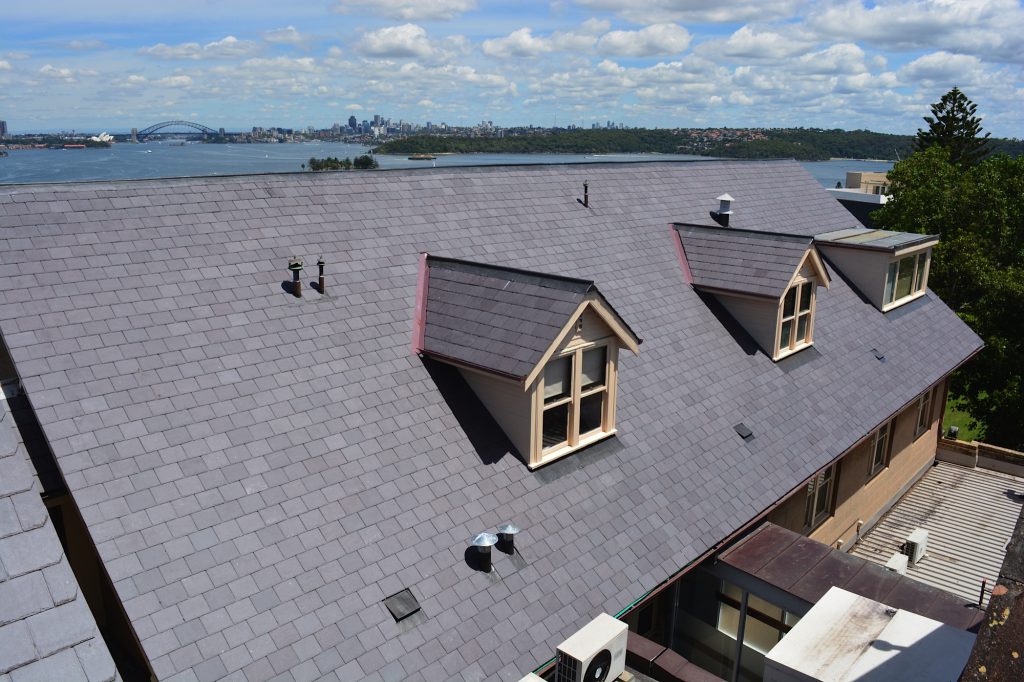
Kincoppal-Rose Bay. Two jobs on one campus. The water tower had been clad in zinc in the late 1970s, and we restored it to its original Welsh Penrhyn slate with lead ridge capping and lead-capped sills. On the health care centre we replaced the roof in Welsh Penrhyn with a lead roll top ridge, new copper valleys and gutters, and bespoke lead vents for extra ventilation. Read the Kincoppal case study.
Strickland House, Vaucluse. The barn on the grounds of this 1850s property, listed on the NSW State Heritage Register, had a Welsh slate roof badly deteriorated by years of neglect. Working through the NSW Government, we restored the Welsh slate with lead valleys, a roll top ridge and copper gutters and downpipes. Read the Strickland House case study.
You can see more of our work in our case studies.
What to ask the slate roofer before you sign
Any experienced slate roofer in Sydney will welcome these questions. A roofer who gets defensive about them is the wrong one for a slate job.
What fixings will you use? The answer should be copper nails or stainless steel slate hooks, or both. Galvanised steel is still used by some, and in Sydney’s humidity it is a false economy, likely to fail at the 40 to 60-year mark on a slate that should run to 100-plus. Fixings are the most common reason a modern slate roof fails early.
Where is the slate coming from? For Welsh slate the specification should name the quarry (Penrhyn or Cwt-y-Bugail) and ideally come with a certificate of origin. Welsh slate is a target for counterfeiting, because the price premium is high enough to tempt relabelled Spanish or Chinese product. For Canadian and Spanish slate, the quarry name should still appear on the paperwork.
What is the written warranty, and on what? Separate it out: the warranty on the slate itself (from the quarry or supplier, so ask for the term in writing), the warranty on workmanship (should be 10 to 25 years for a new install), and the warranty on specific repair work (five years is standard). A single round number without that breakdown is a sign the quote has not been thought through.
What is included in the lead work? The answer should be a specific list: ridges, hips, valleys, chimney back gutters, dormer flashings, apron flashings and penetrations. Not “lead work as required”. Most of our clients book this alongside the slate scope, which is covered under lead and copper flashing.
Do you work on heritage overlays? On any property inside a conservation area in the eastern suburbs or inner west, this is non-negotiable. The roofer should have experience with the local council’s conservation requirements and know which slate types will be accepted. See our heritage roofing work. Where the brief extends to metal roofs on outbuildings, extensions or garages, we also handle zinc roofing and copper and rheinzink work alongside the main slate scope.
For most Sydney homeowners this is a once-in-a-lifetime job. Taking a slower quote from a slate specialist over a fast quote from a general roofer is the difference between a roof that outlives the mortgage and one that needs another trade back in ten years.
Book a slate roof inspection in Sydney
If you are planning slate work on a Sydney property, book a site visit before you take any quote at face value. The slate type, the pitch, the condition of the battens and whether the lead needs wholesale renewal can each shift the price by tens of thousands, and none of that can be assessed from Google Street View. For the visit, have ready the property’s heritage listing status if applicable, the age of the house and any records of previous roof work.
Request a free quote or call Scott on (02) 9695 1451 or 0406 845 612.
Frequently asked questions
What is the best type of slate for a Sydney home?
For a heritage-listed Federation or Victorian home in Sydney, Welsh Penrhyn is still the specification against which all others are measured. For a mid-budget restoration outside strict overlays, Canadian Glendyne strikes the right balance of lifespan and cost. For a modern build where the architect has chosen slate for the look, Spanish Cafersa is the most common choice.
How much does a slate roof cost in Sydney?
In 2026, supplied-and-installed slate costs about $280 to $360 per m² for Spanish Cafersa, $340 to $430 for Canadian Glendyne and $400 to $520 for Welsh Penrhyn, before scaffolding, lead work and GST. A full strip and re-slate of a 150 m² roof typically costs $55,000 to $110,000.
How long does a slate roof last in Sydney?
A properly installed Welsh Penrhyn slate roof in Sydney lasts 150 years or more. Canadian Glendyne runs 100 years-plus. Spanish Cafersa typically lasts 75 to 100 years. The slate is almost always the longest-lived part of the roof, with fixings, lead flashings and ridge mortar failing decades before the slate does.
Can I replace a slate roof with Colorbond in a heritage area?
Usually not. Inside a heritage conservation area, or on a heritage-listed property, Sydney councils generally require like-for-like replacement, so a slate roof is replaced with slate. Check your council’s development control plan and your property’s listing before you plan the job.
Is slate roofing worth it on a new Sydney build?
Slate is worth specifying on a new Sydney build when the design pitch is at least 25 degrees, the budget allows for the install premium (usually two to three times a Colorbond roof), and the owner values a roof that can last 75 to 150 years. On a long hold, slate can outlast two or three metal roofs. On a short hold, you are paying for appearance and longevity rather than saving money.
About the author
Scott Barton is the director of First Class Slate Roofing. Originally from Glasgow, he trained at Cambuslang Roofing College and worked for several UK slate roofing companies before moving to Sydney and founding First Class Slate Roofing in 2013. He has 20 years of experience in slate and heritage roofing and is a member of the Housing Industry Association and the Master Roof Tilers and Slaters Association. Meet the team.